
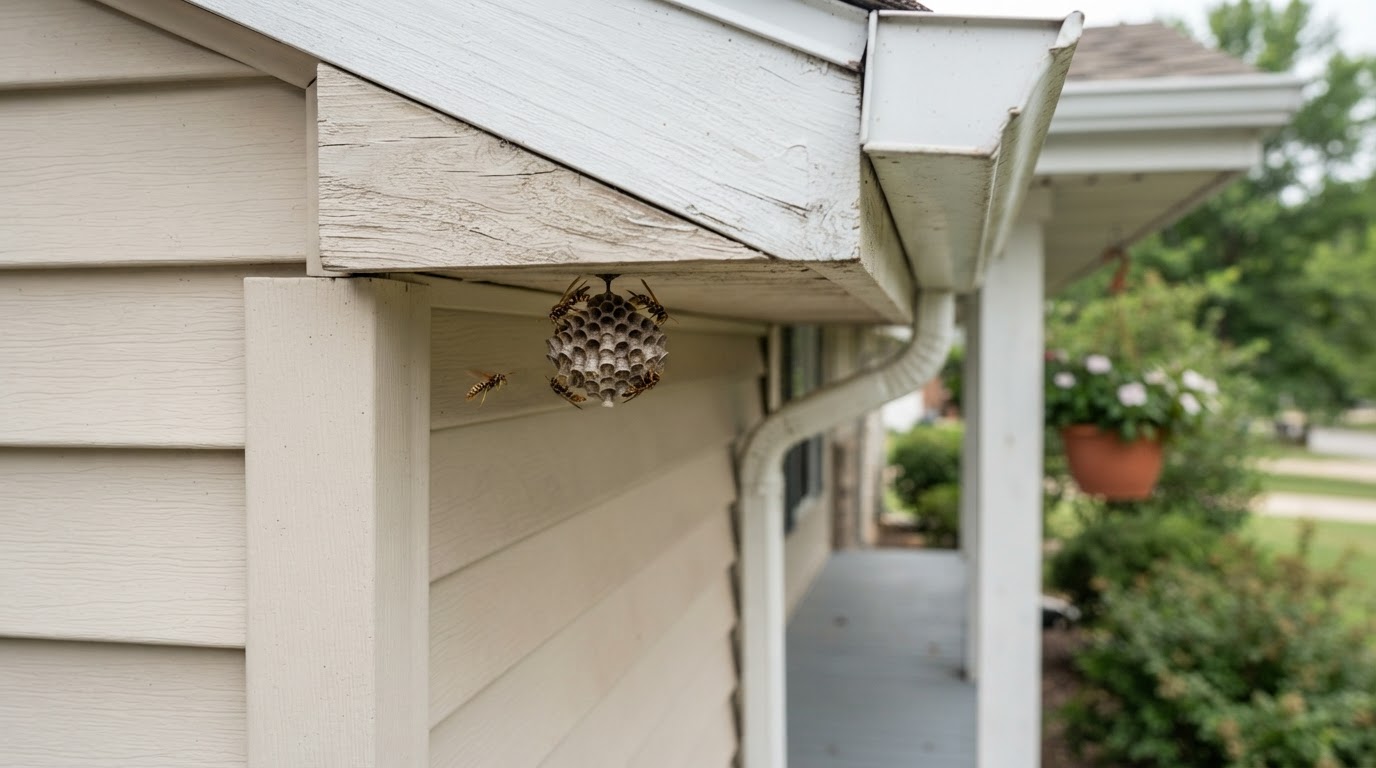
Seeing wasps or yellow jackets repeatedly around your Missouri home? A nest may be nearby, and disturbing it can create a serious risk.
Outdoor structures can offer sheltered nesting sites and access to food. Activity often becomes more noticeable as colonies grow through the warmer months.
Quick Take
Outdoor structures can offer sheltered nesting sites and access to food. Activity often becomes more noticeable as colonies grow through the warmer months.
In this article
Common places nests may be found · How to recognize increased activity · Why nests should be treated cautiously · When professional nest removal is appropriate
Common places nests may be found
Nests may be located in eaves, wall voids, sheds, trees, shrubs, ground cavities, and other protected locations. Some are easy to see; others have a concealed entrance.
How to recognize increased activity
Frequent insects entering and leaving one spot, a visible nest structure, or repeated activity around an outdoor area can suggest a nearby nest. The nest may not be directly visible.

Why nests should be treated cautiously
Stinging insects may defend their nest when disturbed. Hidden nests can be especially concerning near doorways, walkways, play areas, or places people regularly work.
When professional nest removal is appropriate
If you suspect a nest or have noticed aggressive activity, keep distance and arrange professional help. A trained professional can identify the insect and evaluate the location and risks.

Stinging insect help in Columbia
Preferred Pest & Lawn helps property owners address pest activity around homes and outdoor spaces. Contact us if wasps or yellow jackets are creating a concern.
Observe a nest without disturbing it
If a nest is visible from a safe distance, note its general location and where insects appear to enter or exit. Do not climb, tap, spray, plug the opening, or try to remove it. Concealed nests can be difficult to judge from outside, and disturbance may provoke defensive behavior.
Stings and emergency response
Keep people and pets away from nest activity. If someone has breathing difficulty, facial or throat swelling, faintness, or other severe symptoms after a sting, seek emergency medical help immediately.
Frequently asked questions
Can I safely remove a nest myself?
Avoid disturbing nests, especially concealed, elevated, or high-traffic locations. Professional assessment can help reduce risk.
Why are insects entering one gap?
That pattern may indicate a nest or entry route. Observe from a safe distance and do not block it.
When is a sting an emergency?
Breathing difficulty, facial or throat swelling, faintness, or severe symptoms require emergency medical attention.
Activity around the house can have several explanations
Occasional stinging insects in a yard do not always mean a nest is on the house. They may be visiting flowers, searching for food, or traveling through the area. Repeated traffic toward one specific opening is a more useful clue, but it should be observed from a safe distance rather than investigated up close.
Keep people away from the suspected nest area
If a nest is near an entrance or other frequently used space, temporarily redirect foot traffic if that can be done safely. Do not attempt to relocate the nest or seal the opening. Describe the location and activity to a pest professional so they can assess access and risk.
Local help from Preferred Pest & Lawn
Our Columbia-area team starts by understanding the pest, the signs you’ve noticed, and the conditions around your property. We recommend a service approach that fits the situation, explain what’s included, and help you know what to expect—without treating every home the same.
Learn more: professional stinging-insect control.
Need help now? Call Preferred Pest & Lawn at (573) 823-9269 or request service or a quote online. Serving Columbia, Missouri and Mid-Missouri.
Leave a Reply